Worthy service and a friend you can trust.
Expert Crop Advisory Services
Worthy service and a friend you can trust.



The pilgrim planted maize from the Native Americans which was much like volunteer corn sprouting from the previous crop. This corn didn’t look much like our uniform plant culture of todays corn fields. All the genetic variation was expressed some good. Some not so good. But a natural selection process took place that we needed to see the big improvements that we have today.
“In 1972–1978, 100% of the fields in the trial were all conventional till,” he says. “In 1979, the first reported no-till field came in as a practice for our performance trials, and no-till started to expand over time. By 1996, we had the first report for stale seedbed, which is a reduced tillage practice aiming at better weed control. By 2008–2010, only about 15% of the fields in the trial were still conventional till with the rest being minimum or reduced till. From 2013–2020, strip-till was introduced. By 2021, none of our fields in the trials had conventional till, The pilgrim planted maize from the native Americans which was much like volunteer corn sprouting from the previous crop. This corn didn’t look much like our uniform plant culture of todays corn fields. All the genetic variation was expressed some good. Some not so good. But a natural selection process took place that we needed to see the big improvements that we have today.The adoption of crop rotations and reduced tillage accompanied yield improvements in the past 50 years. Photo courtesy of USDA.

The area of raising forages for dairy cows Is an area that I have worked with dairy farms throughout my career. Between 45 and 65% of the Dry Matter intake for dairy cows comes from forages. Whether grown on farm or purchased the dairy farm needs feed high quality forage and when it comes to haylage or silage reduce storage losses by ensuring the wet fodder is at ideal moisture to ensure quality feed until it is used on farm. This may involve keeping the feed safe from the weather. The best dairy farms feed only high quality forages to high producing dairy animals. This commitment to never feed through problem forages is a process of continuous improvement. Dairy I have worked with throughout the years have been successful and even on 4 occasions honored with their county DHIA most improved rolling Herd average. In a recent article in Crops and Soils entitled: “ Agronomy for Dairy Systems” by Bridgett Hilshey the author says Agronomy must take a whole farm systems -based approach because crop production, forage quality, manure nutrients, feed rations, storage and regulatory constraints are tightly interconnected. In an attempt to make the best dairy quality forages the dairy system needs to balance yield and forage digestibility. While harvesting to minimize harvest and on farm storage losses.
Feed samples and laboratory results
This area is rapidly changing as more complete rumen digestion can now be analyzed and with various laboratory tests predicted with amazing accuracy. Not only can we find what ration nutrients are available but when they become available to the high producing cow. In a future article on my website I will cover corn silage but for now I want to only cover hay and haylage. I presented once to a group of young dairy producers the Ten Commandments of Bunker Management
In that I had as the first commandment
1. Honor thy Fodder
And Moisture
As a general moisture I use this range for haylage and hay mixes
bunker/ bag 65-70%
Upright silo. 55-66%
Round Bale balage wrap 28-45%%
And dry hay 9-15% The goal for quality Alfalfa is simply
20% protein
30% ADF
40% NDF
With final ensiled haylage PH 4-5.
As I said modern tests available from or feed labs have broke these simple targets down to analyze each in much more detail.
If a farm and its nutritionist is willing to spend the money their is no limit to what the lab results can predict.
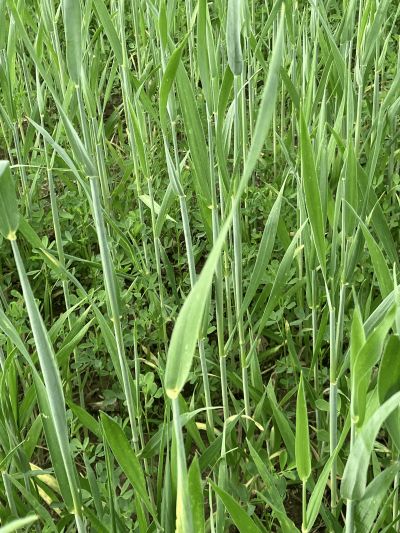
Young cattle are fed a ration that has a higher protein and middle range energy
Feed sales people promote their supplement protein pellets to feed along with poor protein forage
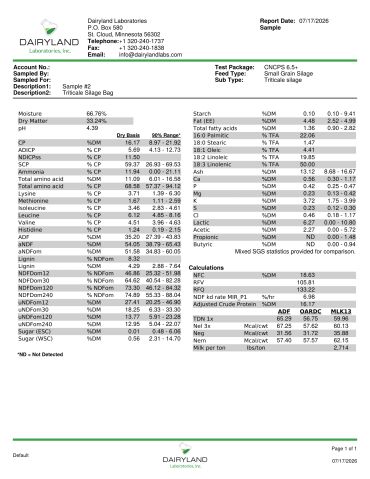
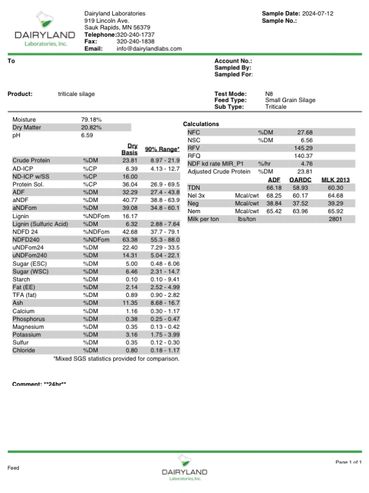
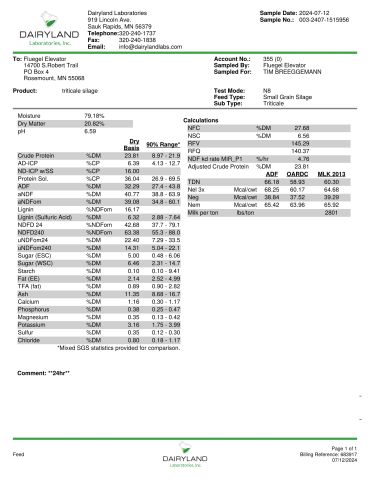
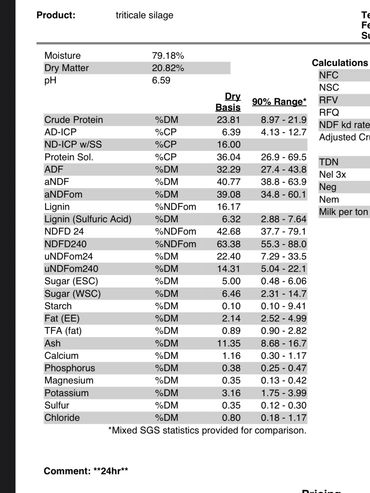
This triticale has the best of both high enough crude protein
(16% C.P.) and middle range energy (67-69 NEL)